
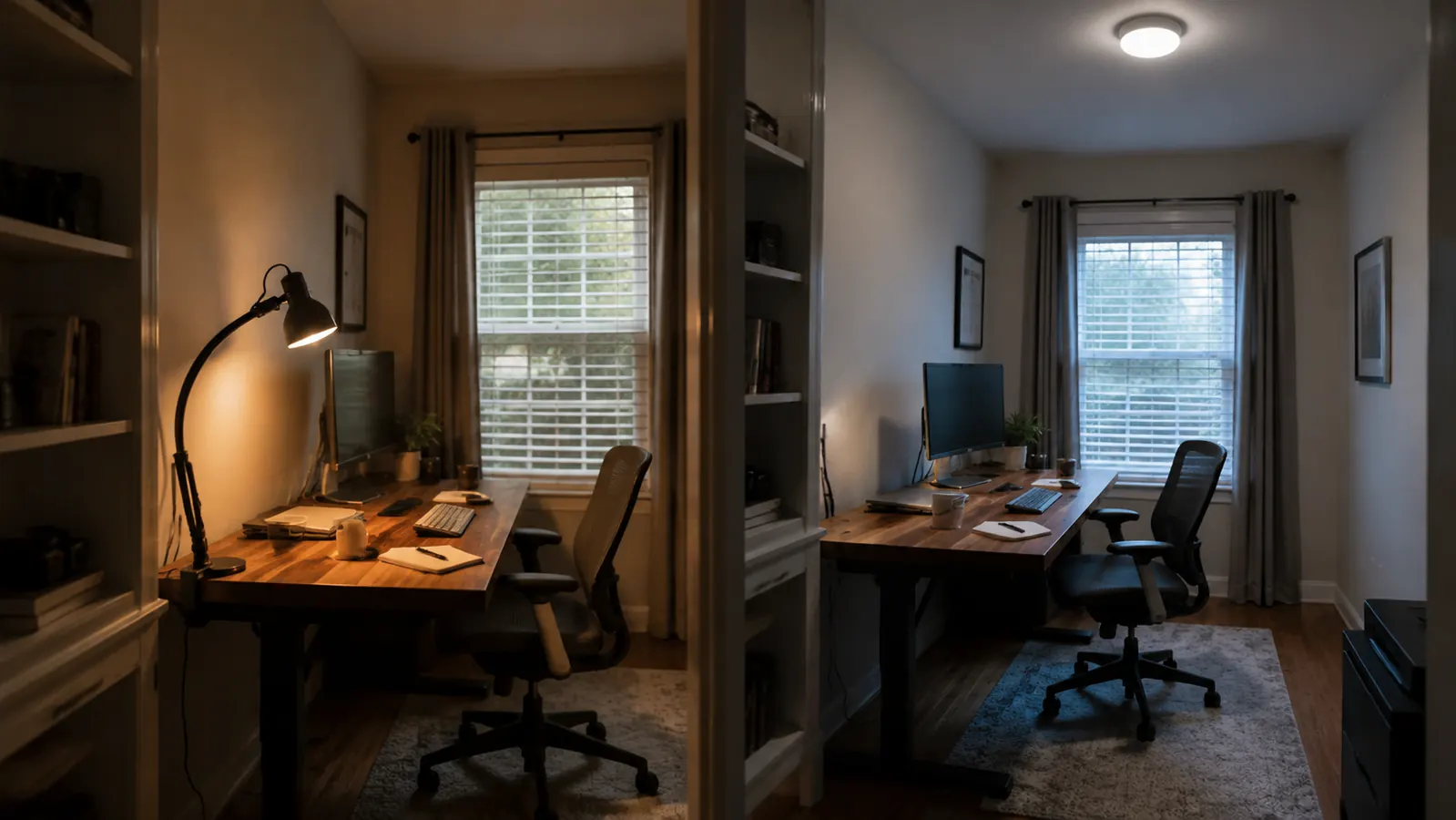
My spare bedroom here in Boise has one ceiling fixture, a builder-grade flush mount that came with the house and puts out flat white light across the whole room. For years I worked under that alone, and by four in the afternoon my eyes would feel dry and my monitor screen would carry a faint glare from the overhead bulb bouncing off the glass. Six months ago I clamped an Airlonv LED desk lamp onto the corner of my desk and started running it alongside the overhead light instead of relying on the ceiling fixture by itself, and the difference in how my eyes felt by the end of a workday was immediate. This comparison is not really lamp versus room. It is close-focused task light versus whole-room light, and the honest answer is that most home offices need both, but if you can only add one, I want to walk through exactly where each one earns its keep.
If you want the short answer up front, overhead lighting wins on covering the whole room evenly and on not costing you anything extra to add if the fixture is already installed, and a dedicated task lamp like the Airlonv wins on the specific job of reducing eye strain and glare exactly where you are reading, typing, or staring at a screen for hours. I ran my desk with just the ceiling fixture for the first three years I worked from this room, then spent the last six months running the Airlonv clamped to the desk corner alongside it, switching the color temperature and brightness through the day. Below is what actually changed, hour by hour, not a spec sheet argument.
I judged this the same way I judge every piece of gear that ends up staying on my desk long term, whether it changes how I feel by four in the afternoon, and whether it holds up to daily use without becoming one more thing I have to fuss with. For two weeks I worked strictly under the overhead fixture alone, tracking when my eyes started to feel dry and when I noticed glare on my monitor. Then I clamped the Airlonv onto the desk, dialed it to a cooler daytime setting, and ran the same tracking for another two weeks. I was not trying to prove one would beat the other outright, because that is not really how lighting works in a home office. I wanted to know which problems each one actually solved.
My desk sits along the back wall of a room that is roughly ten by eleven feet, one window facing east, and the ceiling fixture centered in the middle of the room rather than over the desk itself, which is a common layout problem in converted spare bedrooms. That off-center placement meant the overhead light was never really aimed at my work surface to begin with, it was just lighting the room in general and leaving my desk to catch whatever spilled over. That detail matters for this comparison, because a lot of what the Airlonv fixed was not that overhead light is bad, it is that most home office ceiling fixtures were installed for a bedroom, not a desk, and were never positioned with focused task work in mind.
| What Matters | Airlonv Desk Lamp | Overhead Ceiling Light |
|---|---|---|
| Coverage area | Lights one focused zone, roughly a 20 inch circle across the keyboard and mouse | Lights the entire room evenly, including walkways, shelves, and the doorway |
| Glare on the monitor | Gooseneck aims light down and to the side, away from the screen, cuts glare noticeably | Flat overhead beam bounces straight off a glossy monitor, especially after dark |
| Color temperature | Stepless dial runs 2700K warm to 6500K cool, adjustable anytime mid task | Fixed color temperature set by whatever bulb is installed, usually one tone all day |
| Brightness control | Stepless dimming from near-off to full 100 LED output | Usually one brightness level, or a basic on-off switch at best |
| Setup and cost to add | One clamp-on lamp, plugs into an outlet already near the desk | Already installed in most homes, nothing extra to buy or plug in |
| Desk clutter | Adds a clamp arm and a cord to route on the desk | Nothing added to the desk at all, ceiling stays fully out of the way |
| Early morning or late night use | Works independently of the room, useful before sunrise without waking anyone else | Flipping on the overhead light at 5am lights up the whole house for everyone |
| Best single job | Close, focused task light for reading, typing, and video calls | General room visibility so you are not walking into furniture in the dark |
Where Airlonv Wins
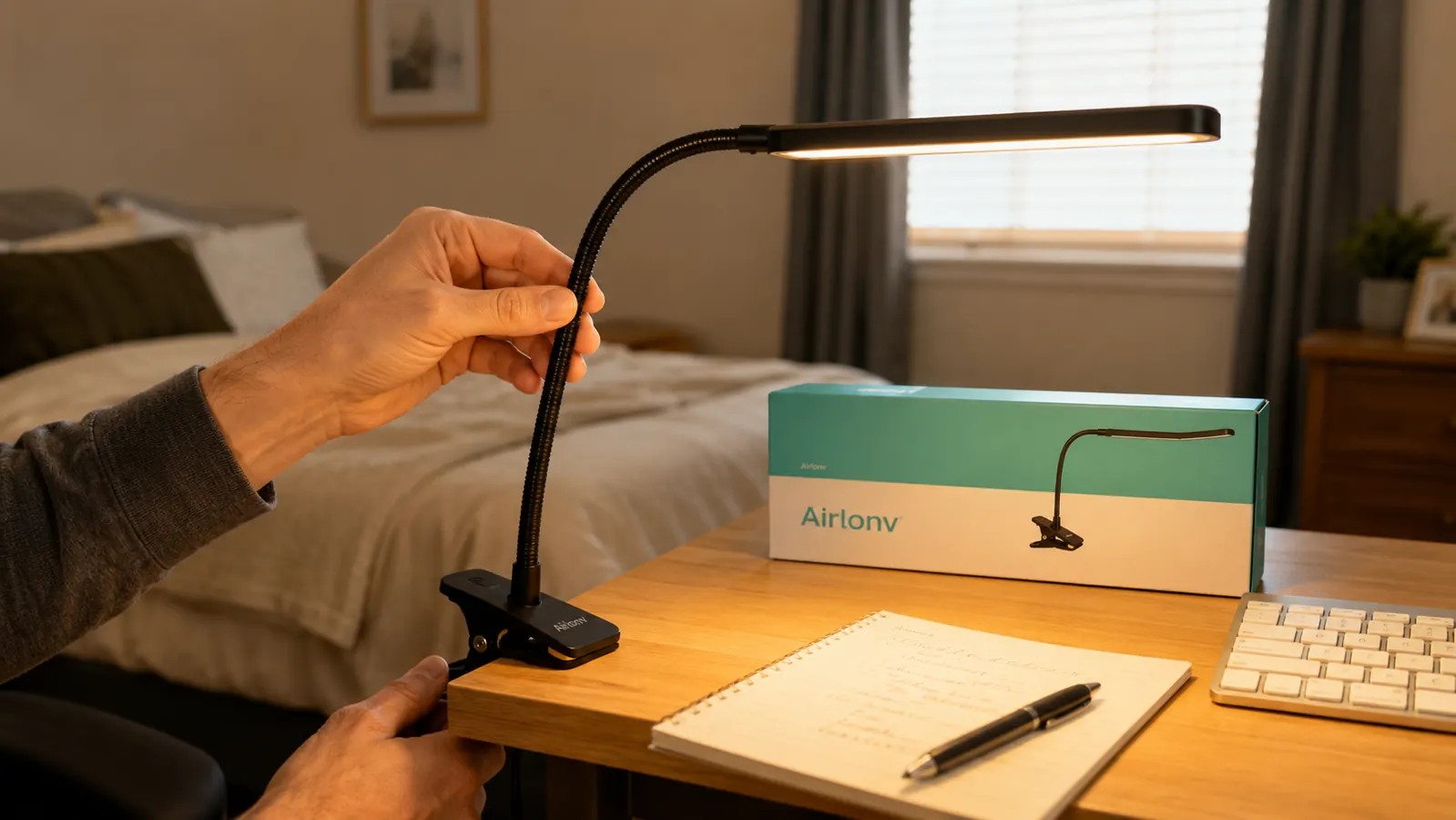
The Airlonv earns its spot on my desk almost entirely because of where the light actually lands. The gooseneck arm lets me point the head down and slightly to the side, so the light hits my keyboard and notepad without throwing a hot reflection back up off my monitor screen. My old overhead fixture used to leave a faint glare across the top third of my screen every evening once the sun went down outside my window, and that glare is gone now that most of my task light comes from the Airlonv instead of the ceiling alone. Since I clamped it on, I have not had to squint or tilt my monitor away from the light source to read anything comfortably.
The stepless dimming and the 2700K to 6500K color range are the two features I actually use every single day, not just once and forget. In the morning I run the Airlonv cooler and brighter, closer to daylight, because it seems to help me wake up and focus faster than the flat warm tone from my ceiling bulb. By early evening I dial it down toward the warmer end and drop the brightness, and that alone has cut down on the eye fatigue I used to feel by the time I shut my laptop for the day. My overhead fixture gives me none of that control. It is either on or off, one color, one brightness, and that was fine for years until I noticed how much a lamp I could actually adjust changed how tired my eyes felt by the afternoon.
There is also a practical case for the Airlonv that has nothing to do with eye strain. My desk sits against the wall opposite the door, and turning on the overhead light at five in the morning to get an early start means lighting up the whole room and, some mornings, waking up whoever else is still asleep down the hall. Clamping the Airlonv to the desk and switching it on gives me exactly the light I need to start working without touching the room's main fixture at all. The clamp itself has held solid through six months of adjusting the arm daily, no wobble, no slipping down the edge of the desk, which matters more than it sounds like it should once you are moving a lamp around several times a day.
I also did not expect the Airlonv to matter much for video calls, but it changed those too. Before I added it, my webcam picture on client calls looked flat and slightly gray, lit only from above by the ceiling fixture, which put a shadow under my eyes and across my desk. Repositioning the Airlonv slightly to one side, angled toward my face instead of straight down at the keyboard, gave my webcam a much more even, natural looking light without buying a separate ring light or streaming light. That is not why I bought it, but after six months it has become one of the small reasons I would replace it with the same lamp if it ever broke.
Where Overhead Lighting Wins
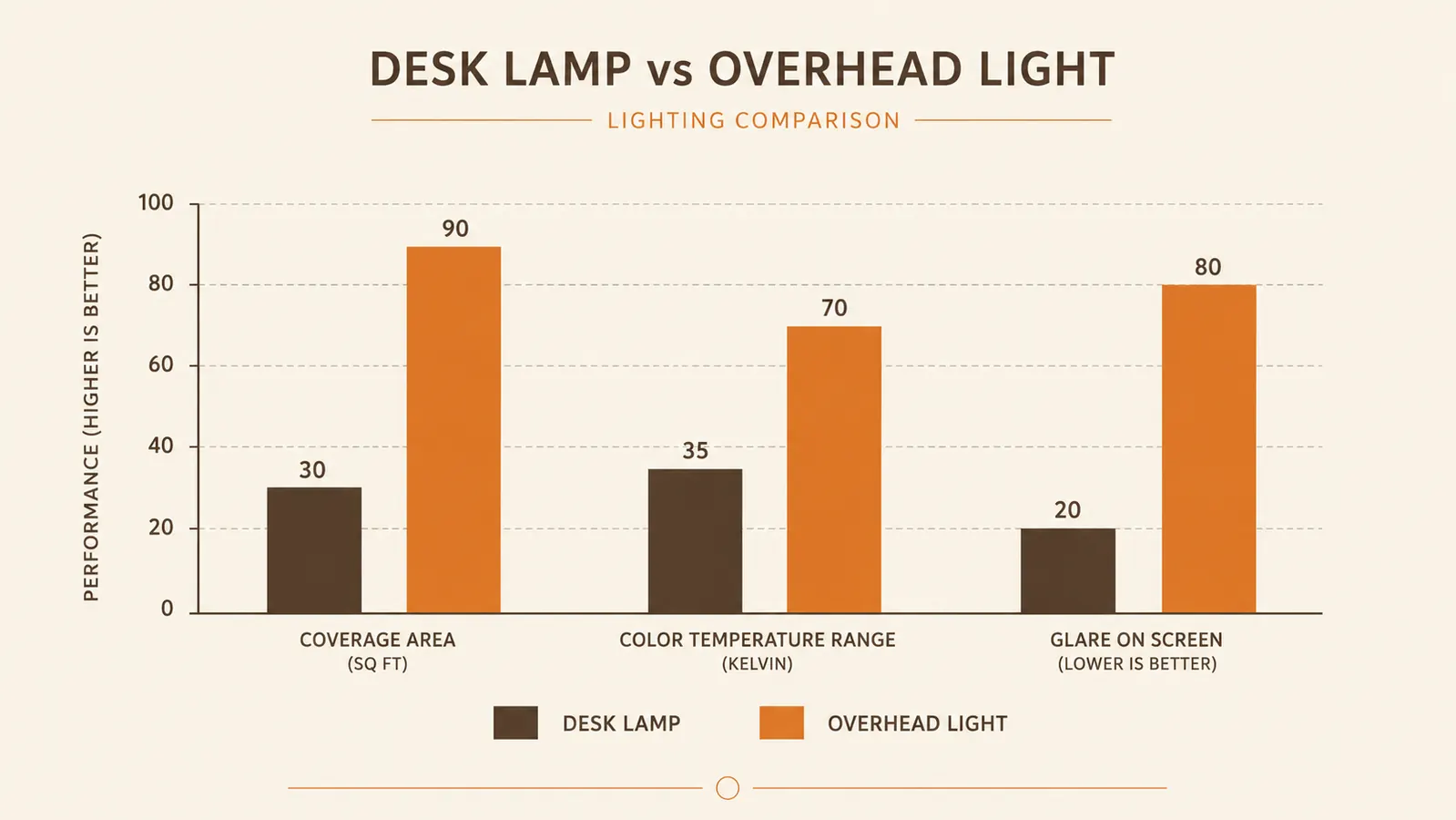
None of that means overhead lighting is obsolete, and I want to be straightforward about where the Airlonv simply cannot compete. A ceiling fixture lights the entire room evenly, not just a 20 inch circle around my keyboard. When I need to find a cable that fell behind the desk, grab a book off the shelf across the room, or just walk to the door without stubbing a toe on a moved chair, the overhead light does that job and the Airlonv does not even try to. A desk lamp, no matter how good, is a single point of light. A ceiling fixture is whole-room coverage, and there is no clamp-on lamp that replaces that.
Overhead lighting also wins on the simplest measure there is, nothing extra to buy or set up. If your home office already has a working ceiling fixture, you are done. There is no clamp to attach, no cord to route across the desk, no extra outlet to find. My spare bedroom's overhead light was already installed when I moved in, and for the first three years I worked from this room, it was the only lighting decision I had to make, which was none at all. That kind of simplicity is worth something, especially if your desk setup is already tight on outlets or you would rather not add one more cord to the mess running down the back of the desk.
It is also worth saying plainly that a desk lamp adds a small amount of clutter that overhead lighting never will. The Airlonv clamps onto the edge of my desk and its arm takes up a little bit of the real estate near my monitor, and the cord has to go somewhere, usually zip tied along the same path as my monitor and keyboard cables. If your desk is small, or you already feel like you are fighting for space, an overhead fixture gives you full room coverage without giving up a single inch of your desktop. That tradeoff is real, and anyone with a genuinely cramped desk should weigh it before assuming a task lamp is automatically the better answer.
Overhead lighting also does a better job of making a room feel normal to be in, rather than making it feel like a lit stage set for one desk. When someone else in the house walks past my open office door, the overhead fixture is what lets them see the whole room without me having to explain that the Airlonv is only pointed at my keyboard and will not help them find anything on the shelf across the room. A desk lamp is built to solve one person's task lighting problem at one desk. A ceiling fixture is built to make an entire room usable for whoever walks into it, and that broader job is one a clamp-on lamp was never designed to do, no matter how good it is at its own narrower job.
Tired of squinting under one flat ceiling light?
Clamping an Airlonv onto my desk fixed the glare my overhead fixture could not. Check today's price on Amazon and see the specs for yourself.
Amazon Check Today's Price on Amazon →
Who Should Buy Which
If you work at a desk for most of the day, spend real hours looking at a monitor, or you have noticed your eyes feel dry or tired by mid-afternoon, add a dedicated task lamp. I wrote up the full six-month version of my experience with mine in a long-term Airlonv desk lamp review if you want the deeper detail on how it has held up daily. I also put together a list of ten reasons a desk lamp reduces eye strain if you are still weighing whether the switch is worth it before you buy anything at all. The overhead fixture in your room is not going anywhere, and it should not, but it was never built to solve the specific problem of glare and eye fatigue that comes from staring at a screen for eight hours a day.
If your home office is more of a shared space, a hobby corner, or somewhere you spend short stretches of time rather than a full workday, the overhead light in the room is probably already doing the job you need. You do not need to clamp a task lamp onto a desk you only use for twenty minutes at a time to pay bills or check email. Save the task lamp purchase for the desk where you actually sit for hours, because that is where a lamp like the Airlonv earns back what it costs in eye comfort. For my own spare bedroom office, where I am at the keyboard most of a normal workday, running both together, overhead for the room and the Airlonv for the close task light, has been the setup that finally got rid of the afternoon eye strain I put up with for years.
One more practical note before you decide. If you already run a decent overhead fixture and your budget only stretches to one purchase this month, I would still tell you to start with the task lamp rather than upgrading the ceiling light, because the Airlonv is solving the problem you actually feel by the afternoon, tired eyes and screen glare, while a nicer overhead fixture mostly solves a problem you probably do not notice, general room ambience. The two are not competing for the same job, and once you frame it that way the decision gets a lot easier. I kept my plain builder-grade overhead fixture exactly as it was and just added the Airlonv next to it, and that combination has been enough.
Ready to stop fighting glare on your monitor?
The Airlonv is the small change that made the biggest difference in how my eyes feel by the end of the day. See its current price on Amazon.
Amazon Check Today's Price on Amazon →