
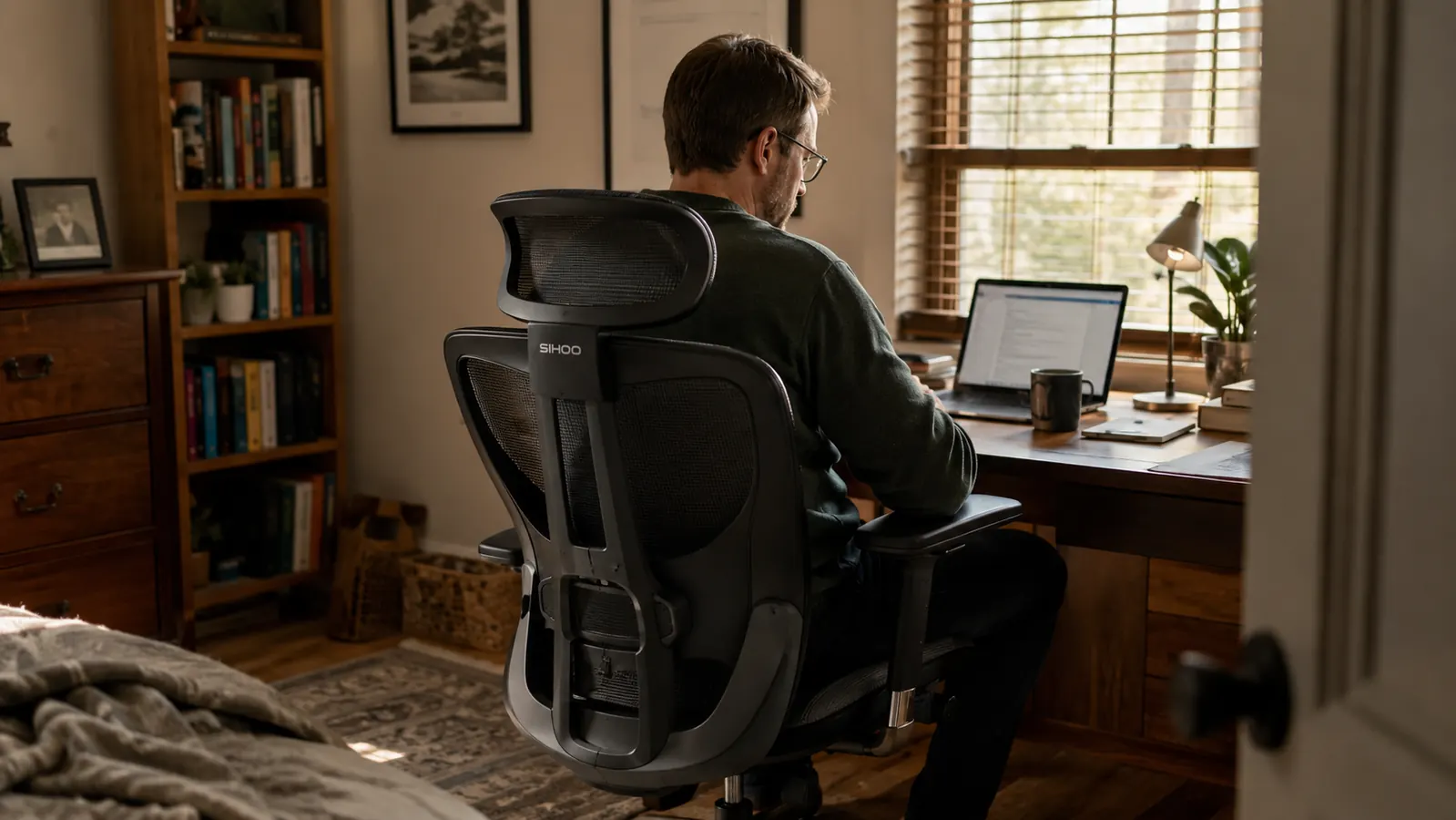
Four months ago my lower back was done arguing with me. I'd been working from the same corner of my spare bedroom in Boise for nine years, and for most of that time I sat in whatever chair was cheapest at the time, a padded task chair that looked fine for about a year and then started sagging in the seat pan until I was basically sitting in a shallow bowl. By hour five of a workday I'd be shifting every few minutes, standing up to stretch, and by 4pm I had a dull ache across my lower back that followed me into the evening. I finally replaced it with the SIHOO B100, and I've now sat in it for eight-hour days, five days a week, for a full four months. This is what actually happened, not a first-impressions post from week one.
I want to be upfront that I bought the SIHOO B100 because of the adaptive lumbar support, not the brand name. I'd never owned a SIHOO product before this. What sold me was the idea of a lumbar pad that moves with you instead of one fixed bump you either fit or don't. Nine years of bad chairs had left me skeptical of any marketing claim involving the word 'ergonomic,' so I went in expecting to be disappointed, and I want to walk through exactly why that changed over the following sixteen weeks.
The Quick Verdict
A genuinely supportive mesh chair for long desk days, with a lumbar system that earns its keep, held back only by a squeaky recline mechanism and armrests that feel a step below the rest of the build.
Amazon Check Today's Price →Still sitting in a chair that fights your back by 3pm?
The SIHOO B100's adaptive lumbar support is built to move with you through an 8-hour day instead of forcing you into one fixed position. Check today's price and current availability on Amazon.
Amazon Check Today's Price on Amazon →How I Tested It
I'm a technical writer, which means my job is basically sitting and typing for most of the day, broken up by video calls and the occasional pace-around-the-room thinking session. My desk sits in the corner of a spare bedroom that gets warm in the afternoon, so breathability mattered to me as much as support. I set up the SIHOO B100 the day it arrived, adjusted the seat height, lumbar depth, and armrests to fit my frame, and then just used it the way I use any chair, no special test protocol, just real workdays.
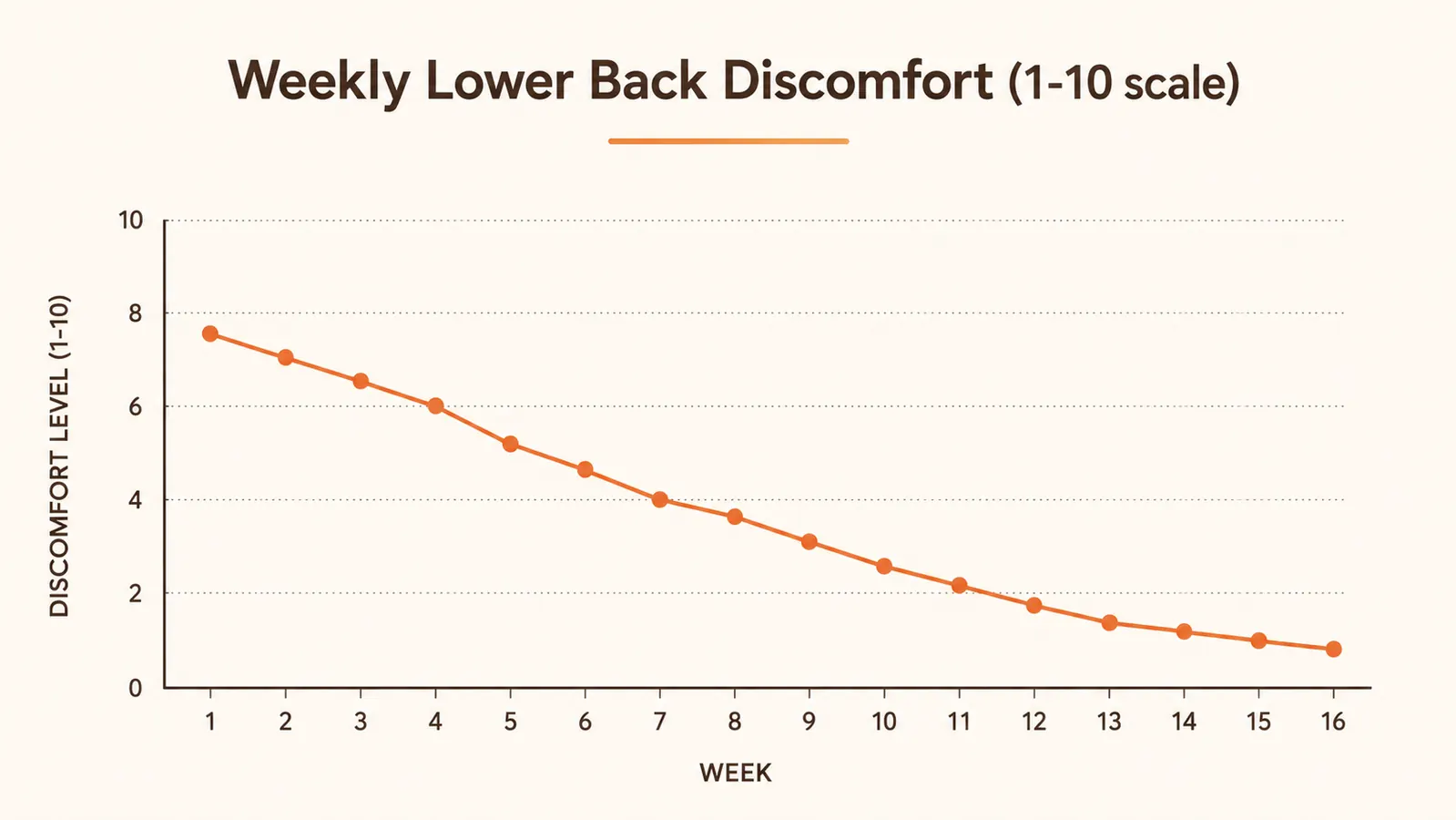
I kept a rough weekly note of how my lower back felt at the end of the day, on a 1 to 10 scale where 10 was the old chair's worst afternoons. I also paid attention to things that don't show up in a spec sheet: does the mesh actually stay cool through a July afternoon in a room without great airflow, does the recline mechanism hold up after months of leaning back to think, and do the casters still roll smoothly on my hardwood floor after regular use.
I did not go easy on it. My desk setup is nothing fancy, a laminate desk from a big box store and a monitor arm I installed myself, so the SIHOO B100 had to work in an ordinary home office, not a showroom. I also weigh a fair bit more than the marketing photos suggest their target user does, and I wanted to know if the seat pan would hold its shape under regular daily weight the way the old chair failed to.
The Adaptive Lumbar Support, Four Months In
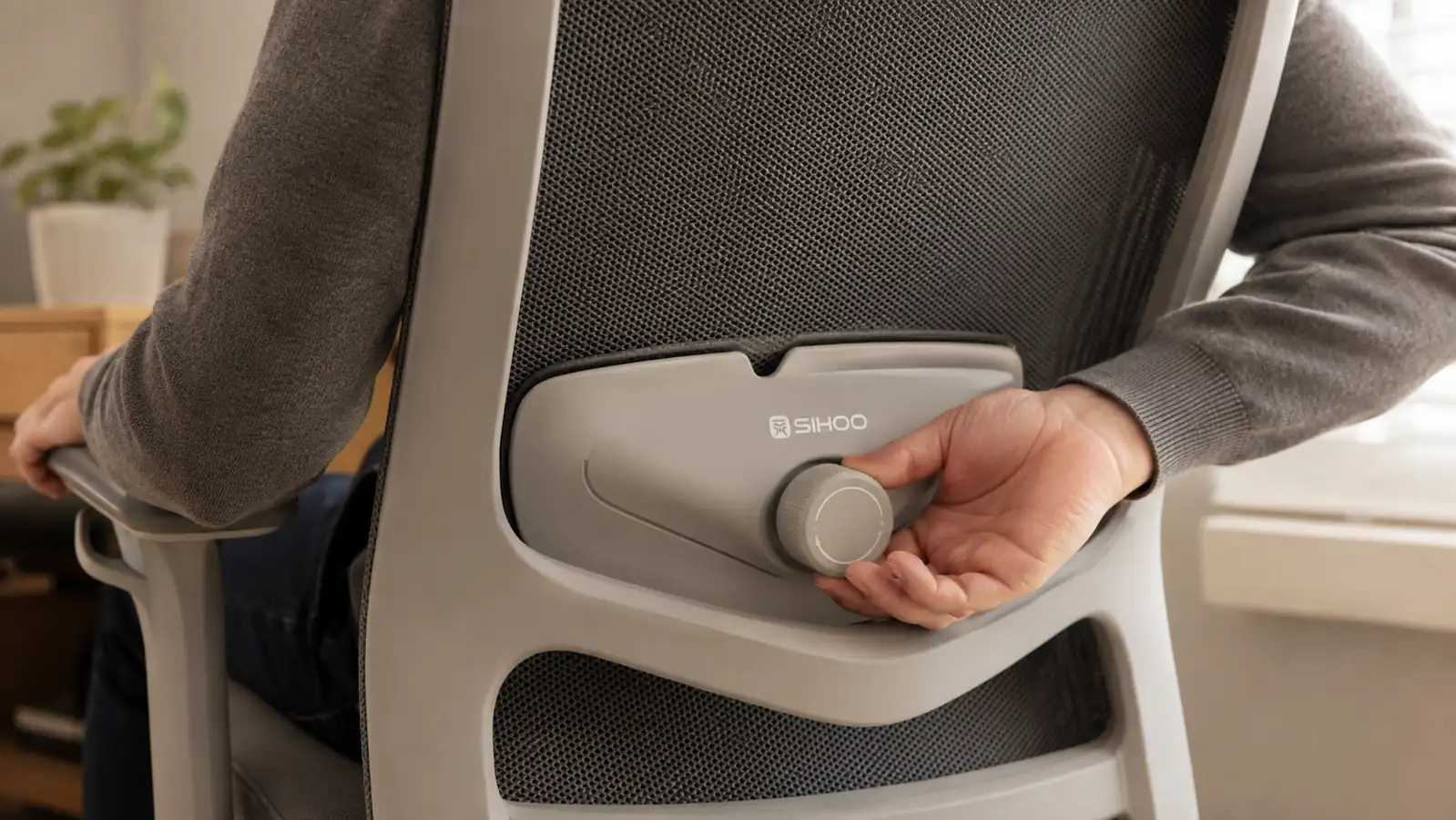
This is the feature that made me buy the SIHOO B100, and it's the one that actually delivered. The lumbar pad on the SIHOO B100 isn't a static bump like the cheap chair I replaced. It has a dial on the back that lets you adjust both the height and the depth of the support, and once I found the right spot, roughly two inches above where I expected based on other chairs I've tried, my lower back stopped complaining by mid-afternoon for the first time in years.
My discomfort notes tell the story better than I can. Week one, I was still at a 6 or 7 most afternoons, partly because I hadn't dialed in the lumbar position yet and partly because my back was still adjusting to actually being supported after years of slouching into a worn-out seat. By week six, most days were landing at a 2 or 3. By week twelve, I was mostly not thinking about my back at all during the workday, which for me is the real win. A chair I have to consciously manage isn't doing its job.
The SIHOO B100's mesh backrest also flexes slightly as you shift, so it's not a rigid wall behind you. I noticed this most during long calls when I'd naturally lean side to side, and the backrest moved with me instead of forcing me back to center. That small bit of give is part of why the lumbar support has held up so well over four months instead of becoming another spot that eventually just presses uncomfortably. I readjusted the dial exactly twice in four months, once in the first week and once after a haircut appointment where I'd slouched all day and came home aching.
Breathability in a Room Without Great Airflow
My spare bedroom office does not have central air vents pointed at it, so by mid-afternoon in the summer it gets warm. My old chair had a foam-padded seat that turned into a heat trap by hour four, and I'd end up standing just to cool off. The SIHOO B100 uses mesh across both the seat and the backrest, and it made a real difference. I never got that sweaty-back feeling that used to send me to the kitchen for a break I didn't actually need.
It's not magic, the room is still warm and I'm still a person sitting in a chair, but the airflow through the mesh keeps heat from building up the way solid foam does. On the hottest days in July, I noticed the difference most around hour six or seven, which used to be exactly when I'd start fidgeting in the old chair. I ran a box fan in the corner on the worst afternoons, and between that and the mesh I stopped dreading the second half of my workday the way I used to.
Alternatives I Looked At First
Before I settled on the SIHOO B100, I spent about two weeks reading through other mesh office chairs in a similar range, mostly other budget-to-midrange ergonomic models with adjustable lumbar claims. A couple had better name recognition, but the reviews kept mentioning the same problem my old chair had, a seat cushion that flattened out within a year of daily use. I also looked at a couple of premium chairs that cost several times more, and while the reviews were glowing, I couldn't justify that jump for a home office setup, especially not knowing if I'd actually notice the difference day to day.
What tipped it toward the SIHOO B100 specifically was the combination of the adjustable lumbar dial and the sheer number of other remote workers describing the same all-day desk use I have. Most of the alternatives I considered had either a fixed lumbar curve or an adjustment so subtle it barely mattered. Four months later, I think that was the right call for my situation, though I'll admit I still wonder occasionally what one of the pricier options would have felt like.
What a Full Workday Actually Feels Like Now
The clearest way I can describe the change is what my 2pm slump used to look like versus what it looks like now. On the old chair, 2pm meant standing up, pacing to the kitchen, coming back and shifting into three different positions before settling again, none of them actually comfortable. On the SIHOO B100, 2pm is mostly just 2pm. I still get up and walk around because that's good for anyone regardless of chair, but I'm not doing it to escape discomfort anymore, I'm doing it because moving is healthy.
The seat depth adjustment also deserves a mention here, since I almost overlooked it when I first set the SIHOO B100 up. Sliding the seat pan forward or back changed how much of my thighs were supported, and getting that right took the pressure off the back of my knees during long stretches of sitting. It's a small adjustment compared to the lumbar dial, but combined with everything else, it's part of why a full eight hours in this chair doesn't leave the same mark on my body that the old one did.

Where the Build Quality Shows Its Limits
I'm not going to pretend the SIHOO B100 is flawless, because it isn't. Around week ten, the recline mechanism started producing a faint squeak when I leaned back past about 20 degrees. It's not loud enough to interrupt a call, but I hear it, and on a video call with a quiet room it's occasionally noticeable. A little silicone spray on the pivot point quieted it down, but it came back after a few weeks and I've just accepted it as a minor annoyance rather than a dealbreaker.
The armrests are the other soft spot. They adjust in height and width, which is more than my old chair offered, but the padding is noticeably firmer than the seat and backrest mesh, and after long typing sessions I sometimes notice pressure on my forearms. I ended up resting my wrists on the desk more than the armrests for typing-heavy stretches, which solved it for me, but it's worth knowing going in if armrest comfort is a priority for you.
Who This Is For
If you sit at a home desk for most of an 8-hour workday, the way I do, and you've been dealing with lower back fatigue by mid-afternoon, the SIHOO B100 is worth serious consideration. It's also a solid fit if you work in a room that runs warm, since the mesh construction genuinely helps compared to a padded foam seat. Anyone replacing an old, sagging task chair like mine will likely notice the difference within the first couple of weeks, even before the lumbar adjustment is fully dialed in.
By week twelve, I was mostly not thinking about my back at all during the workday, and for me, that's the actual win.
Who Should Skip It
If armrest comfort is your top priority, or if you type heavily with your forearms resting on the arms rather than the desk, the firmer padding here might bother you the way it occasionally bothers me. And if a completely silent recline mechanism matters more to you than lumbar support, the squeak that showed up around week ten is worth factoring in, even though a little maintenance keeps it manageable. I'd also point people with a very tight budget toward reading the full honest SIHOO B100 review first, since it goes deeper into value tradeoffs I didn't cover as much here.
If you're still deciding whether a chair upgrade is even the right fix for desk back pain, I'd also point you to 10 reasons an ergonomic chair stops back pain, which walks through the broader case before you commit to any specific model.
What I Liked
- Adaptive lumbar support noticeably reduced my afternoon back fatigue within six weeks
- Mesh seat and backrest stayed cool through warm summer afternoons in a room with poor airflow
- Backrest flexes slightly with natural movement instead of staying rigid
- Height and width adjustable armrests, more configurable than the chair it replaced
- Casters still roll smoothly on hardwood after four months of daily use
- Seat pan held its shape under daily use, unlike the cheap chair it replaced
Where It Falls Short
- Recline mechanism developed a faint squeak around week ten that returns after lubrication
- Armrest padding is firmer than the seat and backrest, uncomfortable during long typing stretches for me
- Assembly took me about 40 minutes and the instructions could be clearer on the lumbar dial
- Headrest is wide but doesn't adjust for depth, only height
Four months of real 8-hour workdays, and my back stopped clocking out early
The SIHOO B100 isn't perfect, but the adaptive lumbar support did what my old sagging task chair never could. If your afternoons still end in lower back fatigue, it's worth a look at today's price on Amazon.
Amazon Check Today's Price on Amazon →