

I get the same question every time someone finds out I switched to a standing desk two years ago: is it worth spending real money on a premium desk like Uplift, or does a budget option like the FEZIBO get you most of the way there? I have now spent a full year standing and sitting at the FEZIBO in my spare bedroom here in Boise, and I spent two weeks on a friend's Uplift Desk running the same workday side by side, same monitor height, same eight hour writing schedule, to give you a real answer instead of a spec sheet argument.
For context, I am 5'11", I write technical documentation for a living, and my lower back started aching by early afternoon most days once I hit my mid thirties sitting at a plain folding table in a room barely big enough for a desk and a bookshelf. I bought the FEZIBO because it was the desk I could actually afford for a spare bedroom office, 48 by 24 inches with a maple top and a white frame, and the footprint fit my room without eating the walking space I needed to get around it. I have used it daily for the past year. My friend has run an Uplift Desk in his home office for about three years, and letting me borrow his setup for two weeks gave me the closest thing to a fair test I could put together without owning both desks myself.
I will say upfront that I expected the Uplift Desk to simply win on every point, because that is the story premium desks usually tell about themselves before you actually try one. It did not shake out that cleanly. Some of what the Uplift Desk does better is genuinely hard to notice unless you use it for a full week straight, and some of what the FEZIBO does well for the money surprised me enough that I still have not felt any real urge to replace mine after this comparison ended.
I also want to be honest about how I judged this, because most desk comparisons online are written by someone who owns one desk and read a spec sheet for the other. I tracked three things across both stretches of testing, how steady the desktop felt at standing height while typing, how long it actually took to switch between sitting and standing during a normal workday, and whether either desk gave me any reason to think twice about buying it again. A desk that makes you hesitate before raising it is a desk you will stop using within a month, and that is the real failure mode I was watching for.
| Feature | FEZIBO | Uplift Desk |
|---|---|---|
| Frame motor | Single dual-motor lift system, rated smooth and quiet up to about 250 lbs | Commercial-grade dual motor, rated for a heavier load and faster lift speed |
| Height range | Roughly 28 to 47.6 inches, covers sitting through standing for most heights | Wider range with optional frame sizing, better fit for taller or shorter users |
| Desktop options | Fixed 48 x 24 inch maple laminate top, splice board seam down the middle | Dozens of solid wood, bamboo, and laminate top choices in custom sizes |
| Memory presets | 3 programmable height presets on the control panel | 4 programmable presets plus a keypad with USB charging built in |
| Stability at full height | Slight wobble when typing fast at max height, settles once you stop moving | Noticeably steadier at full height, minimal wobble even typing hard |
| Assembly | About 45 minutes solo with the included tools and printed instructions | Closer to 90 minutes, heavier components, easier with a second person |
| Manufacturer warranty | 5 years on the frame and motor | 7 to 15 years depending on the frame and top combination chosen |
| Typical price tier | Budget-friendly, well under most standing desk budgets | Premium tier, several times the cost of the FEZIBO once you add a real top |
Where FEZIBO Wins
Where the FEZIBO wins is obvious once you look at cost against what you actually get for a normal spare bedroom setup. My FEZIBO arrived with everything I needed, and I had the frame together and the maple top attached in under 45 minutes working alone with the included tools, no extra trip to the hardware store required. The printed instructions were clear enough that I never had to look up a video, which is more than I can say for some flat-pack furniture I have put together over the years. The price gap between the FEZIBO and a comparable Uplift Desk build is wide enough that I still had money left over for a monitor arm and a proper desk lamp after buying it, and for someone furnishing a first home office on a real budget, that gap matters a lot more than a marginal stability upgrade you might not even notice week to week.
As a one-person assembly, the FEZIBO is genuinely manageable, which matters more than it sounds like it should when you are setting up a home office by yourself on a weekend. The desktop is the heaviest single piece, and even at 48 by 24 inches I could tilt it onto the frame and line up the mounting holes myself without asking anyone to hold the other end steady. The legs, crossbar, and control box all went together with the included allen wrench in the order the instructions laid out, no guesswork, no leftover hardware at the end. The Uplift Desk is a different experience solo. The frame components run heavier, and the thicker solid wood top options make it harder to line the desktop up on the crossbars without it sliding while you thread the screws. My friend needed his wife's help the day his arrived, and he told me flatly he would not have wanted to attempt it alone.
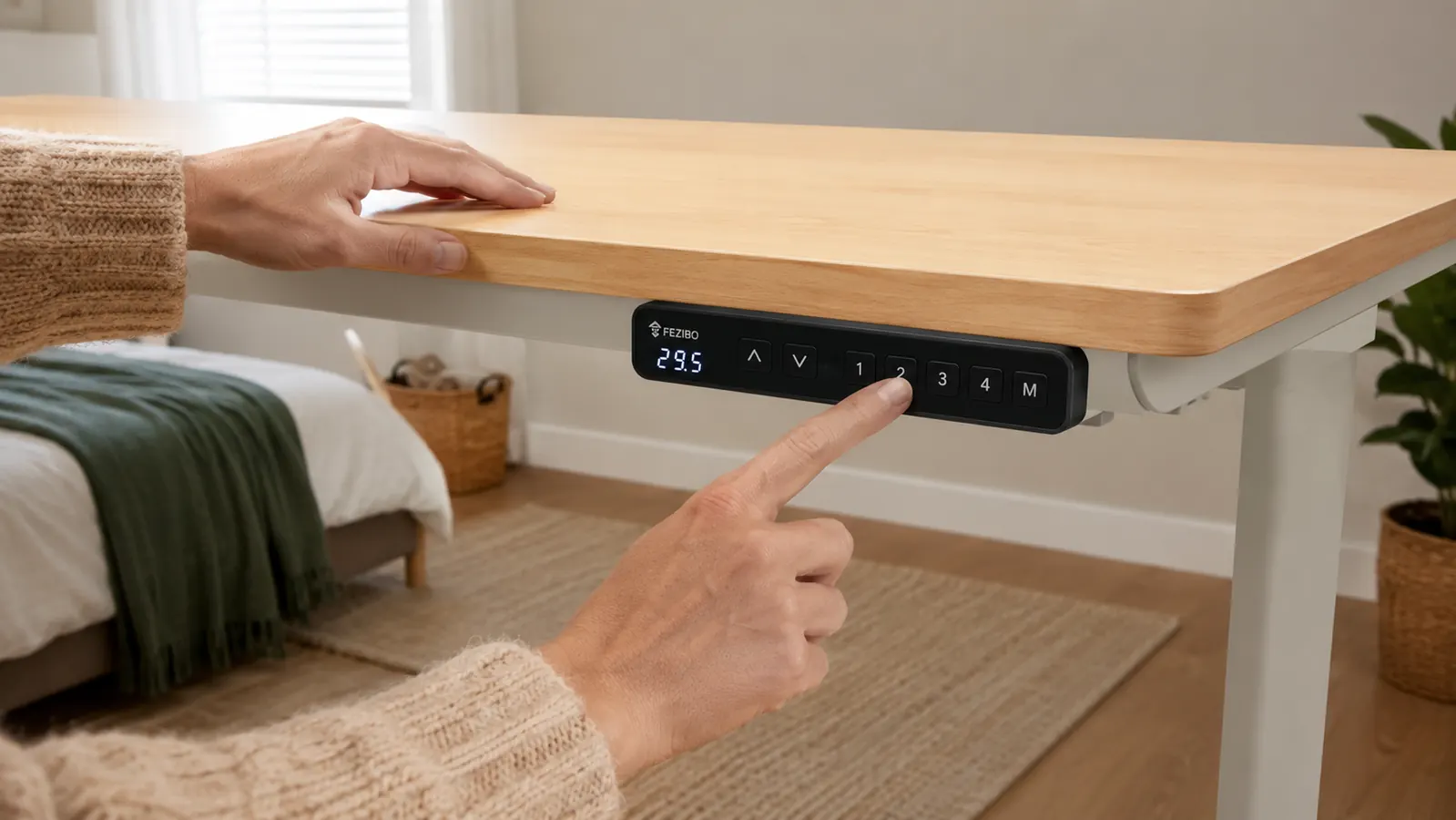
The three memory presets on the FEZIBO are also genuinely useful in daily practice, not just a spec sheet checkbox. I programmed one for sitting, one for standing while typing, and one slightly higher for standing calls where I want to gesture without hitting the desktop, and pressing a single numbered button gets me there in about eight seconds without having to hold anything down. The FEZIBO's white frame also blends into my spare bedroom's light walls better than I expected, and the splice board seam down the middle of the maple top has not opened up or shifted after a full year of daily use, which was one of my bigger worries going in.
Noise is another place the FEZIBO holds its own. The dual motor lift is quiet enough that I can raise or lower the desk during a video call without anyone on the other end noticing, and it has not developed the grinding sound my old cheap desk riser started making after a few months. Between the price, the working memory presets, and a full year with no wobble, no squeaks, and no motor issues, the FEZIBO is the desk I would point almost anyone toward if they are setting up a home office on a real, limited budget.
One more thing worth mentioning is how forgiving the FEZIBO has been about my cable mess. The frame has a channel along the back edge that keeps my power strip and cables mostly out of sight, and after a year of raising and lowering it daily, nothing has snagged or pulled loose. I also run a small under-desk hook for my headphones and a laptop stand off to one side, and neither has thrown the desk off balance even at full standing height. That is a small detail, but it is the kind of thing that only shows up after real, repeated use, and it is one more reason the FEZIBO has held up better than I expected for what it cost.
The FEZIBO fixed my sit-stand routine for a fraction of what the Uplift Desk costs once you add a real desktop.
Where Uplift Desk Wins
Where the Uplift Desk pulls ahead is stability and the sense that it was engineered for a decade of daily use rather than built to hit a price point. At full standing height, typing hard on my friend's Uplift Desk, I barely felt any wobble, where the FEZIBO has a slight give at its tallest setting that settles once I stop typing but is noticeable if I am a fast typist mid-sentence. If you plan to stand at your desk most of the day and type quickly the entire time, that extra stability is worth something a budget frame cannot fully match.
The frame difference matters most for taller users, since more body weight sits higher above the base once the desk reaches full extension. My friend is 6'2", and when he raises the Uplift Desk to its top setting, the dual-motor columns still overlap enough to keep it steady under his weight. When I put the FEZIBO at its own top setting and had him lean into it typing, the wobble he felt was more noticeable than what I feel at my own top height, mostly because I am shorter and never push the frame that close to its limit. If you are over six feet tall and plan to work near max height every day, that stacked leverage is the real reason the Uplift Desk feels steadier, not just a marketing line.
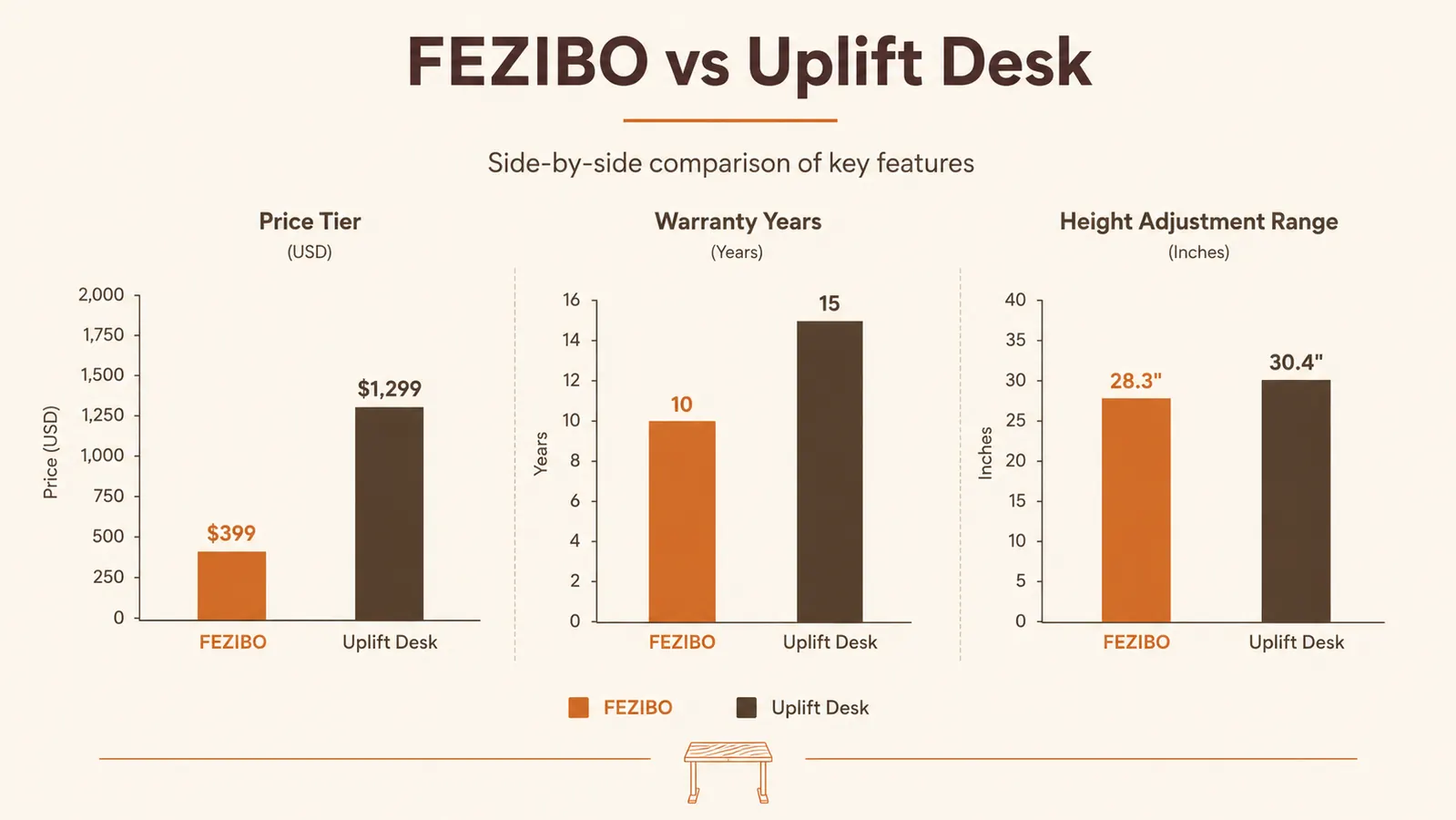
The Uplift Desk also wins on customization in a way that matters if your home office is not a standard rectangle. My friend chose a solid bamboo top in a custom width to fit an odd-shaped nook in his spare room, something the FEZIBO's fixed 48 by 24 inch top simply cannot do. He also picked a darker wood finish that matches the rest of his built-in shelving, which is not an option you get with the FEZIBO's single white-frame, maple-top combination. The warranty gap is real too, up to 15 years on some frame and top combinations versus the FEZIBO's 5, and if you plan to keep one desk for a decade or more, that longer coverage starts to justify more of the price difference.
The desktop question is worth thinking through before you buy either one. The FEZIBO ships with one maple laminate top in one size, and that is what you get, no swapping it later without buying a separate desktop entirely. The Uplift Desk takes the opposite approach, you are really buying a frame, and the top is a separate decision with dozens of wood, bamboo, and laminate options across different sizes. That flexibility is genuinely useful if your room needs a nonstandard footprint or you already own a slab you want mounted, but it also means the sticker price on an Uplift frame alone understates what you will actually spend once you add a real top to it.
It also ships with a heavier-duty motor rated for a bigger load, so if you run dual monitors on articulating arms, a laptop dock, and a printer all on the same desktop, the Uplift Desk has more margin before you start pushing against its rated capacity. The keypad on my friend's Uplift Desk has a built-in USB port for charging a phone, which is a small convenience the FEZIBO's simpler control panel does not include, and the height range on the Uplift Desk's frame options fits a wider spread of user heights than the FEZIBO's single fixed range.
There is also a presence to the Uplift Desk that is hard to quantify but easy to notice the moment someone walks into the room on a video call. The solid wood top reads as real furniture rather than a home office add-on, and if you do client-facing calls from your home office regularly, that visual weight is part of what you are paying for. It did not change how steady my back felt by the end of the day compared to the FEZIBO, but I noticed it every time I sat down at it.
What Happens at Year Three
What happens at year three really comes down to what the warranty means in practice, not just what it says on paper. My FEZIBO is only a year in, so I have not personally lived through a control box failure, but the 5 year warranty covers a failed control box or motor within that window, and other FEZIBO owners I have talked to online describe a straightforward parts replacement rather than shipping the whole desk back. The Uplift Desk's warranty runs up to 15 years depending on the frame and top you chose, covering you well past where a budget desk's coverage would already have run out, and Uplift has a similar reputation for replacing a bad control box directly instead of making you box up the entire frame. If a control box is going to fail on either desk, it tends to happen early or not for a long stretch after, so the Uplift Desk's longer term buys peace of mind for someone who wants to stop thinking about their desk for a decade more than it buys any real difference in how likely a failure is in year three specifically.
Still working from a desk that will not move?
The FEZIBO is the desk I actually kept after this comparison. Check today's price on Amazon before you decide you need to spend Uplift Desk money.
Amazon Check Today's Price on Amazon →
Who Should Buy Which
If you are setting up a home office on a real budget, working in a spare bedroom with a standard desk footprint, or you just want a sit-stand desk that gets you moving during the day without a big investment, the FEZIBO is the one I would point you to. I have a full year on mine now with no wobble at normal working height, no motor issues, and a maple top that still looks like new, which is the kind of detail that tells you a budget desk was built with some care. If you want the fuller picture of how mine has held up over time, I wrote a longer year-long review of the FEZIBO standing desk that covers the motor, the presets, and the top in more depth. I also put together a list of ten reasons a standing desk boosts focus if you are still deciding whether a sit-stand setup is worth the change in the first place.
If you type fast at full standing height and notice every bit of wobble, you need a custom desktop size or material to fit an odd-shaped room, you run a heavier load of monitors and equipment than a typical single-monitor setup, or you plan to keep one desk for the next decade and would rather pay once and be done with it, the Uplift Desk is the more defensible purchase. Neither desk is the wrong answer here. They are built for two different budgets and two different tolerances for spending more up front, and after standing at both for full workdays, I can say the FEZIBO solved my actual problem without asking me to spend Uplift Desk money to do it.
Ready to stop sitting all day and just fix it?
I went from a stiff afternoon back to a routine I actually stick with after switching to the FEZIBO. See its current price and specs on Amazon.
Amazon Check Today's Price on Amazon →